What Is Local AI?
Local AI is artificial intelligence that runs directly on your own device — your phone or computer — instead of sending your requests to a company's server over the internet.
The simple definition
When you type a message to most AI assistants, that message travels over the internet to a data center, gets processed by a large model running on powerful servers, and the answer travels back to your screen. That's cloud AI, and it's how tools like ChatGPT, Gemini, and Claude normally work.
Local AI skips that trip entirely. The AI model lives on your device, and the "thinking" happens on the same chip that runs your camera app or your calculator. Nothing has to leave your phone for you to get an answer. That's also why local AI is often called on-device AI.
Cloud AI = your question goes to a server. Local AI = your question never leaves your device.
The same idea under different names
One reason local AI is hard to search for is that the industry has not settled on a single name for it. These terms all describe the same arrangement — model weights stored on your own hardware, inference performed there, no request sent to a provider:
- Local AI and on-device AI — the most common general terms, and the ones used throughout this site.
- Local LLM — the same thing stated more precisely, since the model doing the work is a large language model. Common among developers; a search for "local LLM on iPhone" is looking for exactly what this page describes.
- Offline AI or an offline chatbot — named for the consequence rather than the mechanism. Because nothing is sent anywhere, the assistant keeps working with no connection at all.
- Edge AI — the same principle described from the network's point of view, where the phone is the "edge" rather than the data center. More common in industry writing than in consumer apps.
- Private AI — a claim about the outcome, not a description of the architecture. It is the least reliable of these terms, because a cloud app can also market itself as private. Four checks separate the two.
How local AI is different from cloud AI
Two things change. Cloud models are enormous — often far too large to fit on a phone — so they run on server farms with specialized hardware, while local models are built or shrunk to fit the memory of a single device. And with cloud AI your messages have to be sent somewhere to be answered, whereas with local AI there is nothing to send in the first place.
Those differences play out in cost, capability, offline behaviour and privacy in ways worth seeing side by side: ChatGPT vs. local AI compares the two directly, row by row.
Why local AI is becoming possible now
Smaller, smarter models
AI researchers have gotten much better at compressing large models into smaller ones that keep most of the original's ability while using a fraction of the memory. A model that needed a server rack a few years ago can now run on a phone.
Faster phone chips
Modern smartphones ship with chips designed specifically to accelerate AI calculations. That extra horsepower is what makes it realistic to hold a fluid conversation with an AI model without a server doing the heavy lifting.
What local AI is good for
- Privacy — there's no server that ever sees your conversation.
- Reliability offline — it keeps working with no Wi-Fi, no signal, and no service outages. See why offline AI matters.
- Consistent cost — no server bills to pass on, so local AI apps often skip the monthly subscription model entirely.
- Speed for simple tasks — no network round-trip means answers can start appearing almost instantly.
What local AI can't do (yet)
Local models are smaller than the largest cloud models, so they're usually not the best choice for extremely complex reasoning, huge documents, or tasks that need live internet information, like today's news or current stock prices. For everyday conversation, writing help, and quick questions, though, a well-built local model can feel just as capable.
Local AI in action: Cloak
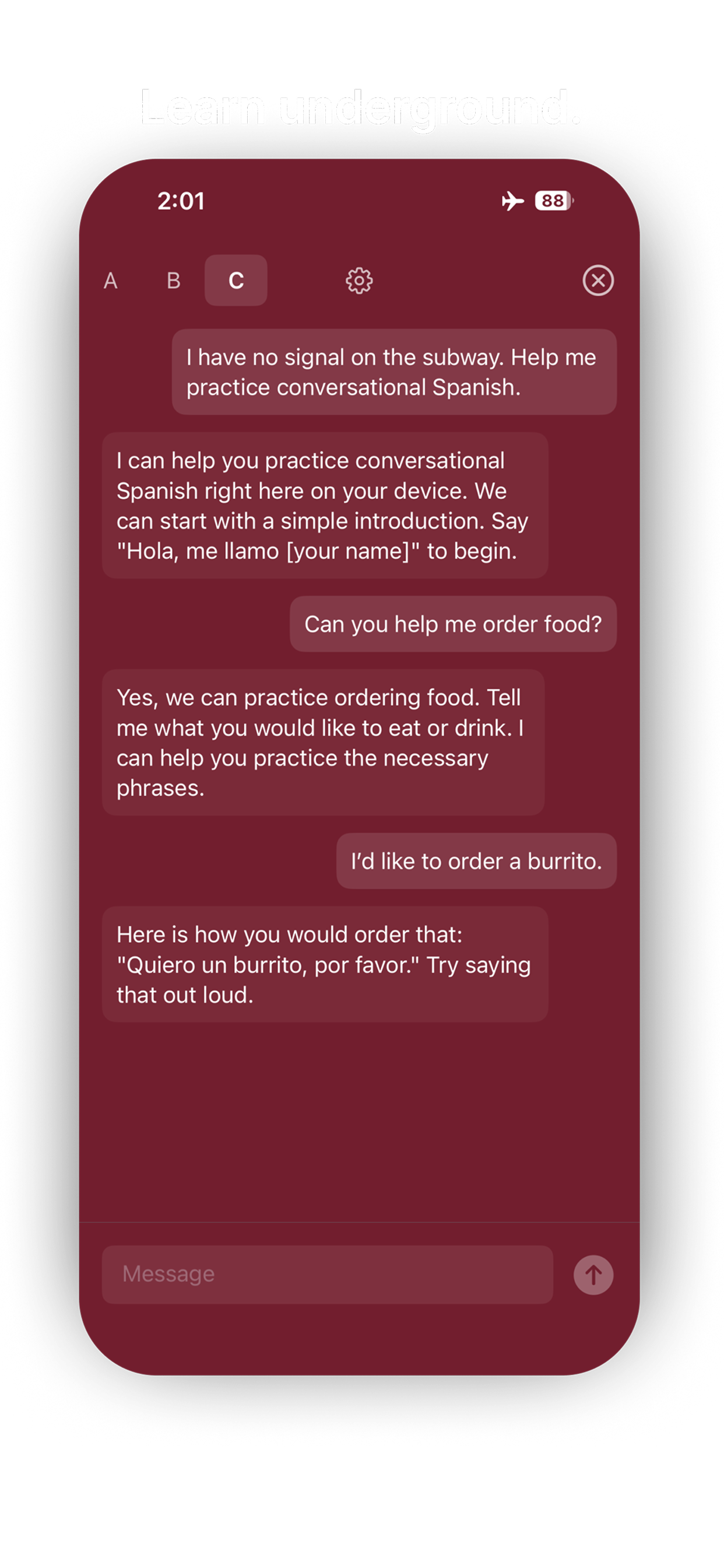
A concrete example of everything above is Cloak: Local AI Chat, an AI chat app for iPhone and iPad built by Polyaura. Cloak is local AI as a finished product: it downloads its model once, then runs that model on your device from then on — no server sees your messages, no account is required, and no internet connection is needed to chat. It is free for the first 20 messages, then a $0.99 one-time purchase for unlimited messages rather than a subscription, and it is available on the App Store.
Specifications, pricing, device requirements and the full set of questions people ask about it are on the Cloak product page.
Try local AI on your iPhone
Cloak is a private, local AI chatbot that runs entirely on your iPhone — no cloud, no account. Try 20 messages free, then $0.99 one-time for unlimited. Download the model once, then chat anywhere, connected or not.