How to Tell If an iPhone AI App Is Actually Private
"Private" is a marketing word on the App Store, not a technical one. Four checks tell you whether an app means it.
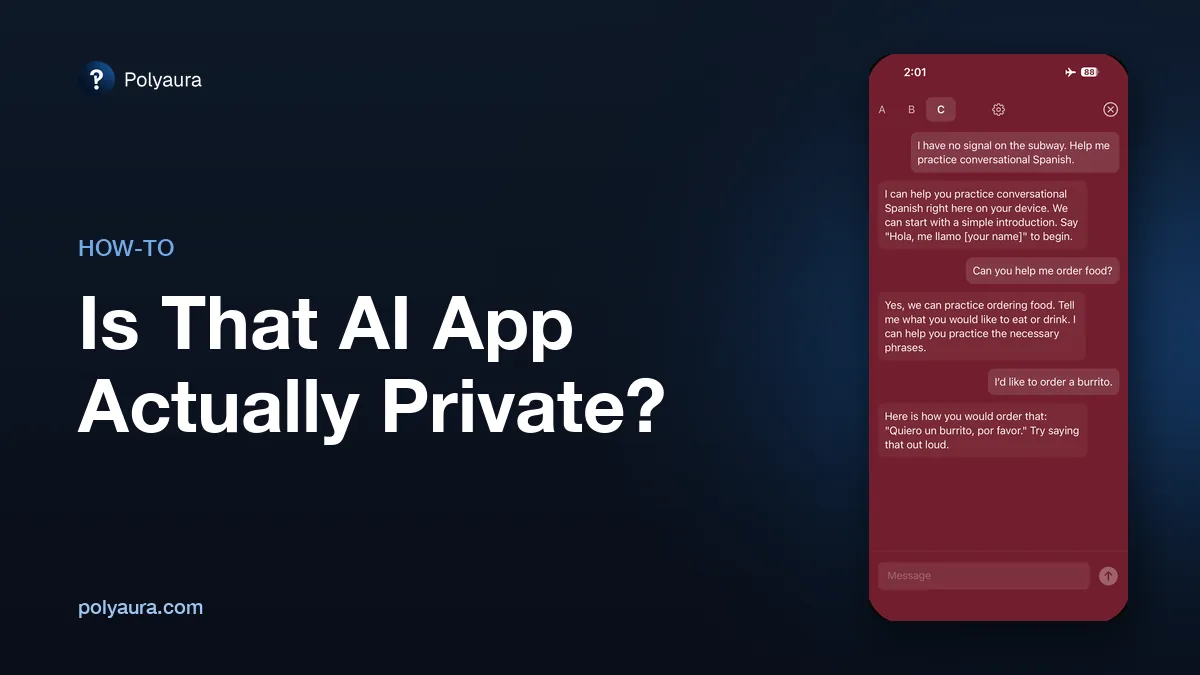
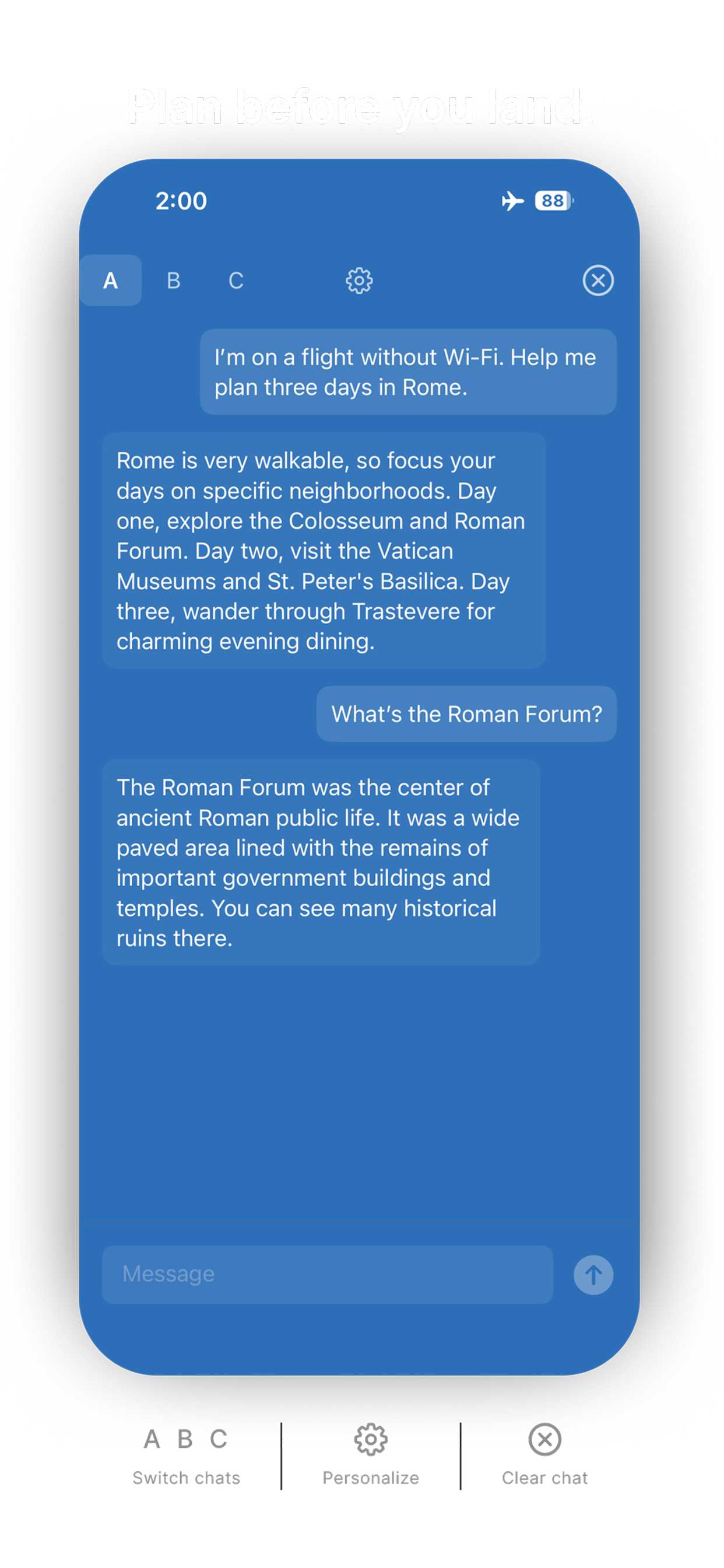
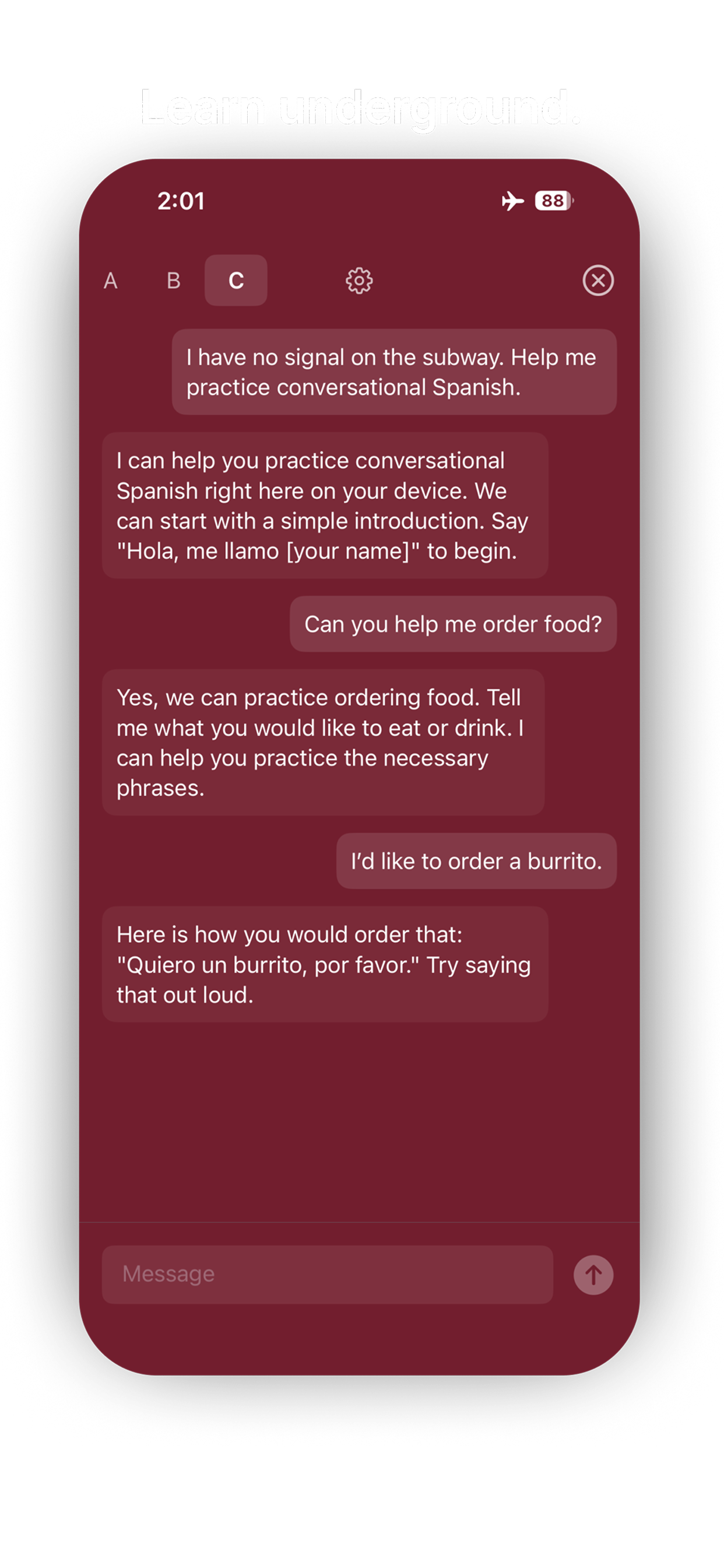
The fastest way to find out is to put your iPhone in airplane mode and send the app a message. If it answers, the model is running on your device and your conversation is not going anywhere. If it stalls, spins, or shows an error, it was sending your messages to a server all along — whatever the listing says.
Airplane mode on. Send a message. An app that answers is running the model locally. An app that cannot is a cloud app, no matter how it is described.
Why the word "private" isn't enough
Almost every AI app claims to respect your privacy, and most are being honest about their intentions. But there are two very different things that claim can mean.
The first is a promise: your messages do go to a company's servers, and the company undertakes to handle them carefully — not to train on them, to delete them after a period, to encrypt them along the way. That can be entirely trustworthy. It is still a policy, it can change, and it depends on the company keeping its word.
The second is a structural fact: the model runs on your phone, so there is no server that ever receives the conversation. Nothing has to be promised about data that was never transmitted. That is what local AI makes possible, and it is the version the four checks below are testing for.
Four checks before you trust an AI app
1. Does it answer with the network off?
This is the decisive one, because it cannot be faked. Turn on airplane mode, confirm Wi-Fi is off too, and send a message. A local model will reply as normal. Note that many on-device apps need one initial download before this works, so do the test after setup rather than on first launch.
2. Does it require an account?
An account exists so that a server can associate requests with a person. An app whose model runs on your device has no particular need for one. A required sign-up before you can type anything is a strong hint that there is a server on the other end doing the work.
3. What does the privacy policy actually list?
Skip the reassuring opening paragraph and look for the specifics: what is collected, what is stored, what is transmitted, and to whom. Check the App Store listing's own privacy summary too. Vague commitments to "your privacy matters" with a long list of collected data types underneath are the pattern to watch for.
4. Does it describe where the model runs?
Apps that genuinely run locally tend to say so precisely — "on-device", "runs locally", "works offline", or a named model that is downloaded to the phone. Apps that avoid the question and speak only about encryption or security are usually describing how your data is protected in transit to their servers, which is a different claim.
What tends to fail, and why
Most AI apps are, at their core, a window onto a company's infrastructure. Your message is sent off to be processed and is often retained afterwards; some services use conversations to improve future models unless you opt out, and many keep chat history for as long as the account exists. None of that is necessarily wrong — it is a reasonable trade for the capability that large cloud models offer, which is covered in ChatGPT vs. local AI — but it is the opposite of privacy by construction.
What passing looks like
Cloak: Local AI Chat, from Polyaura, is built to pass all four. The model runs on the iPhone or iPad, so it answers in airplane mode; there is no account and no login wall; the app has no analytics and no third-party SDKs; and the only network request it makes is the one-time model download. It is free for the first 20 messages, then a $0.99 one-time purchase for unlimited messages, and its device requirements are listed on the Cloak product page.
It is not the only app that passes. Several on-device iPhone apps are compared on exactly these points — accounts, pricing, offline operation, models — in the best offline AI apps for iPhone.
An app that passes all four
Cloak runs its model entirely on your iPhone — no cloud, no tracking, no account. Try 20 messages free, then $0.99 one-time for unlimited. Try the airplane-mode test yourself.